God Can Redeem Anything: Why Nothing in Your Story Is Beyond His Reach
What do you do when life feels completely out of control? When suffering seems to be around every corner, and no matter where you turn, it feels like chaos? If you've ever asked, “God, why is this happening?” you're not alone.
There's something Paul wrote to a struggling church in Rome nearly 2,000 years ago that can change the way we look at the things we're walking through today.
We're in part three of Game Changer, a series through Romans 8, a chapter often described as the heart of the Gospel. And it's important to remember who Paul was writing to. This wasn't a group of people living easy, comfortable lives. The early Christians in Rome knew what it meant to suffer.
Following Jesus could cost you your career, your relationships and even your family. Poverty was common, and persecution was a real possibility in a culture filled with competing religions and gods. On top of all of that, there was tension within the church itself as Jewish and Gentile Christians tried to figure out how to follow Jesus together despite their very different backgrounds.
Paul wasn't writing to people who needed a motivational speech. He was writing to people who knew what it felt like for life to be hard. And he wasn't going to give them an easy answer to a difficult question. Instead, he gave them hope.
Paul begins Romans 8:18 with these words: “Yet what we suffer now is nothing compared to the glory he will reveal to us later.”
That's a pretty bold statement when you're talking to people who are suffering. Paul isn't minimizing their pain or pretending it isn't real. He's reminding them that suffering isn't the end of the story.
That's important because one of the misconceptions that can quietly derail our faith is the idea that following Jesus should make life easier. We can start to believe that if we're doing everything right, our circumstances should eventually fall into place. But that's not the promise of Scripture.
Following Jesus isn't a guarantee of a comfortable life. It's the assurance that our suffering isn't meaningless and that God can redeem even the hardest parts of our stories.
That brings us to one of the most familiar, and sometimes most misunderstood, verses in the Bible. Romans 8:28 says, “And we know that God causes everything to work together for the good of those who love God and are called according to his purpose for them.”
We need to be careful with that verse because it doesn't say that everything that happens is good. It doesn't say everything that happens is God's will. And it certainly doesn't mean that every painful thing we experience will eventually make sense to us.
There is a lot we don't know. We don't know why some things happen. We don't know why some prayers seem to go unanswered. We don't know why one person experiences something and another person doesn't. There are questions we'll carry for a long time, and some we may never get answers to.
But Paul tells us something we can know.
God is working.
We may not understand what he's doing. It may not look like what we would have chosen. It may not happen on our timeline. But God is not absent from our stories.
Scholar Ben Witherington describes it this way: “This does not mean everything that happens is good, or even everything that happens is God's will. To the contrary, it says God is like a weaver, weaving together all sorts of things to a good end.”
Think about a show like Chopped. The chefs are given a basket filled with ingredients that don't necessarily make much sense together. Maybe there's a potato pancake, some purple kohlrabi, a Korean melon and something completely unexpected. They didn't choose the ingredients, but they're still responsible for figuring out what to make with them.
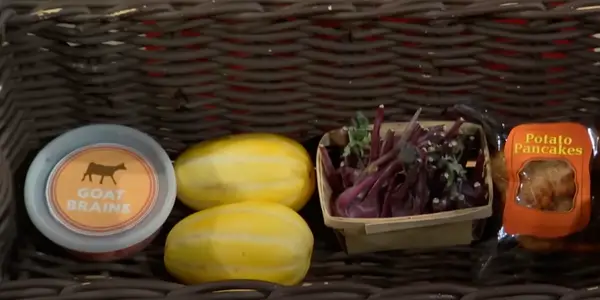
The ingredients aren't necessarily good or bad. They're simply what they've been given. The skill is in knowing what to do with them.
In a much greater way, God can take the things we never would have chosen and weave them into something good.
He doesn't have to cause something to redeem it.
That's an important distinction. God doesn't have to be the author of something painful in order to work through it. He can bring good out of tragedy. He can redeem heartbreak. He can use even our failures and our sin to continue his work in us.
Nothing in your story is beyond God's reach.
But there's another part of Romans 8 that helps us understand what “good” actually means.
Sometimes we read Romans 8:28 and assume that God is promising to make our circumstances better. We think “good” means the situation will eventually work out the way we wanted it to. The relationship will be restored. The diagnosis will change. The job will come through. The thing we've been praying about will finally happen.
Sometimes God does change our circumstances. But that's not the promise Paul is making.
Just look at what he says next in Romans 8:29: “For God knew his people in advance, and he chose them to become like his Son…”
That's the good God is working toward.
God's goal isn't simply to make our lives easier. He's making us more like Jesus.
Sometimes that happens because our circumstances change. Sometimes it happens even though our circumstances don't change at all.
God can use disappointment to reshape what matters to us. He can use failure to reveal something in us that needs to change. He can use suffering to deepen our trust in him. He can use seasons we never would have chosen to make us more dependent on him.
That doesn't mean we have to pretend those seasons are good.
You don't have to call your pain good to believe that God can do something good with it.
You don't have to be grateful for the hurt itself. You don't have to understand why it happened. You don't have to come up with an explanation that makes everything make sense.
You can simply trust that God isn't finished.
Maybe the question you've been asking is, “God, why is this happening?”
That's a fair question. There are moments when that's exactly what we want to know.
But what if there's another question we could ask?
“God, how do you want to shape me through this?”
That question doesn't make the pain disappear. It doesn't give us all the answers. But it changes where we're looking.
Instead of only looking for God to change what's happening around us, we begin to look for what he might be doing within us.
All of the things in your life that you wish were different, all of the pain from your past, all of the uncertainty you're carrying right now, none of it is beyond God's reach.
We will never have an explanation for everything that happens. We will never know all the whys. But Paul gives us something better than an explanation. He gives us a promise.
God is still working.
He sees more of your story than the part you're living right now. He isn't surprised by the next chapter. He isn't finished with you. And he isn't wasting the things you've walked through.
God is playing the long game. His purpose isn't simply to give you the life you would have planned for yourself. He's working to make you more like Jesus.
So when life doesn't make sense, when you find yourself asking why, maybe the next question isn't, “How do I get out of this?”
Maybe it's, “God, how do you want to shape me through this?”
Because God can redeem anything.
And whatever you're walking through right now, God isn't done with you yet.