You probably don’t need me to convince you that life is complicated. You’ve lived the ups and downs. You’ve seen the pains and sorrows. It’s become clear that anything can happen and anything will happen. No matter your political affiliation, religious background, or income, this is something we all share.
This is the final post in a series called “It’s Complicated.” We’ve spent three weeks thinking about how we approach hard times, and this time I want to get practical. Specifically, I want to talk about our emotions and how we can uncomplicate our lives by thinking about them differently.
It Starts With How We Think
At the root of so much of this is simply the way we think.
“We destroy every proud obstacle that keeps people from knowing God. We capture their rebellious thoughts and teach them to obey Christ.” (2 Corinthians 10:5, NLT)
It doesn’t matter how things are going or where you’re headed. We’re always susceptible to unhelpful thoughts. Paul tells us not to let our thoughts run rampant, whether that means catastrophizing or idealizing, but to take them captive. Hold what’s on your mind up to the truth and reality of Jesus.
To see why that matters, let me introduce you to Elijah.
The Prophet Who Ran
Elijah was a prophet, a spokesman for God, and he was hard to miss. The Bible describes him as a hairy man wearing a leather belt. He was fresh off the biggest moment of his life. In a showdown with the prophets of Baal, he had called down fire from heaven and proven the power of God.
You’d expect a celebration. Instead, Elijah landed in the hardest circumstance of his life. King Ahab had watched the whole thing, gone home, and told his wife Jezebel, and she was not impressed.
“So Jezebel sent this message to Elijah: ‘May the gods strike me and even kill me if by this time tomorrow I have not killed you just as you killed them.’” (1 Kings 19:2, NLT)
His incredible high turned into an even lower low. What should have made him a hero made him a target. Even though he had just watched God’s power on full display, he was afraid.
“Elijah was afraid and fled for his life.” (1 Kings 19:3a, NLT)
My Emotions Are a Gauge
Elijah’s response teaches us something first: my emotions are a gauge.
Our feelings are real and valid, and engaging with them is part of being human. Pete Scazzero puts it this way in Emotionally Healthy Spirituality: our feelings are part of what it means to be made in the image of God, and cutting them out of our spirituality slices off an essential part of our humanity.
Think of your emotions like a light on the dashboard. If you’ve seen the tire pressure light come on in the last few weeks, you know it means it’s time to check your tires. I love that. Back in my day, we just waited until the car sat lopsided because a tire was so low. Now we get a warning before it gets that bad. Too little air, dirty oil, an empty gas tank: a working gauge helps us avoid disaster.
When our emotions run high, we’re tempted to do one of two things.
We ignore them. That works in the moment, but it isn’t sustainable. You can only take so much before your emotions rise to the surface.
We overreact. When your coffee order is wrong and it feels like the end of the world, it isn’t about the coffee. It’s about the other thing you’ve let fester.
Your emotions are designed to get your attention. They tell you something is up so you can deal with it before catastrophe strikes.
So what does Elijah do with his? He feels his life is in danger, and he runs.
“He went to Beersheba, a town in Judah, and he left his servant there. Then he went on alone into the wilderness, traveling all day.” (1 Kings 19:3b, NLT)
The first leg of that trip, from Mount Carmel to Beersheba, is about 120 miles, roughly six days for a typical traveler. His emotions told him something was wrong. He felt powerless and abandoned, and he did something about it. Then this happens:
“Then he lay down and slept under the broom tree. But as he was sleeping, an angel touched him and told him, ‘Get up and eat!’ He looked around and there beside his head was some bread baked on hot stones and a jar of water! So he ate and drank and lay down again.” (1 Kings 19:5-6, NLT)
Picture that. You go to bed feeling like the world is ending, and an angel wakes you up with fresh bread and water.
Elijah felt deeply, and there’s no doubt he was reeling. But his emotions didn’t get the final say. He waited them out, and eventually he felt better and got back on the road. He headed for a place with deep spiritual significance. He surely knew the story of God meeting Moses on Mount Sinai, and that’s where he went.
“What Are You Doing Here?”
Think about the last few days Elijah has had. He defeated the prophets of Baal with fire from heaven. He vindicated God and put the pagans to shame. Then his life was threatened, he went on the run, and now he’s finally at Sinai.
“But the Lord said to him, ‘What are you doing here, Elijah?’” (1 Kings 19:9b, NLT)
God’s first words aren’t “Good work, bro!” It’s closer to, “What in the world are you up to? How did you end up here?”
“Elijah replied, ‘I have zealously served the Lord God Almighty. But the people of Israel have broken their covenant with you, torn down your altars, and killed every one of your prophets. I am the only one left, and now they are trying to kill me, too.’” (1 Kings 19:10, NLT)
I am the only one left. No one gets me. No one understands. I don’t fit. I don’t belong.
Your emotions are real and valid, but keep this in mind: my emotions are a gauge, not a guide. They can’t make your decisions for you or get the final say. They can’t be your grounding or your reality. When something hits you deeply, give yourself space to understand the feeling before you let it decide your next move.
In her book Whole Brain Living, Dr. Jill Bolte Taylor describes what she calls the 90-second rule. Her research suggests that when something triggers an emotional response, the initial chemical reaction in the body can run its course in about 90 seconds. That burst is involuntary. How you respond afterward makes all the difference.
So whatever you think or feel in that first burst, hold it captive. Wait it out, and then let it inform your decision rather than make it for you. Your emotions tell you that something is happening. They shouldn’t dictate what you do. Take a deep breath, bring the emotion honestly to God, and ask whether the conclusion you’ve reached accounts for everything you know.
One more thing. You may need much longer than 90 seconds to work through what you’re carrying. Some things in life won’t just get better, and you can’t navigate them alone. In those seasons, one of the best things you can do is find a qualified professional to walk with you. If you’re not sure where to start, we’d love to help. We have a list of qualified professionals who can help you work through whatever is on your heart.
A Gentle Whisper
Elijah’s story unfolds over a long journey, sustained by the care God provides. When he reaches the mountain, God invites him to stand in his presence.
“‘Go out and stand before me on the mountain,’ the Lord told him. And as Elijah stood there, the Lord passed by, and a mighty windstorm hit the mountain. It was such a terrible blast that the rocks were torn loose, but the Lord was not in the wind. After the wind there was an earthquake, but the Lord was not in the earthquake. And after the earthquake there was a fire, but the Lord was not in the fire. And after the fire there was the sound of a gentle whisper. When Elijah heard it, he wrapped his face in his cloak and went out and stood at the entrance of the cave.” (1 Kings 19:11-13, NLT)
After the windstorm, the earthquake, and the fire, Elijah hears a gentle whisper and steps to the mouth of the cave. God speaks to him again and gives him another chance to explain what he’s experiencing. Elijah repeats the same complaint, including his belief that he’s the only one left. That detail matters for anyone who has prayed sincerely and still felt overwhelmed afterward.
God keeps the conversation going and gives Elijah specific direction. And that brings us to the final truth: my emotions are a gauge. God’s voice is my guide.
Notice that things don’t instantly get better. God gives Elijah a place to go and something to do.
“Then the Lord told him, ‘Go back the same way you came, and travel to the wilderness of Damascus.’” (1 Kings 19:15a, NLT)
Poor Elijah. He doesn’t get somewhere new or a cushy new assignment. God says, go back to where you were and keep doing the work. The instructions include appointing kings and calling Elisha to succeed him as prophet. And then God says this:
“Yet I will preserve 7,000 others in Israel who have never bowed down to Baal or kissed him!” (1 Kings 19:18, NLT)
Remember when Elijah said he was the only one left? God reminds him that he was never alone. God had been with him the whole time, and there were 7,000 others who had stayed faithful. Elijah’s loneliness was real, and it had become part of how he understood everything happening around him. But his feelings were not reality.
We can experience something similar when disappointment starts shaping the story we tell ourselves. A difficult season at work can leave us wondering whether we have anything to contribute. A strained friendship can lead us to assume we don’t matter to anyone. Those feelings deserve our attention, and the conclusions that come with them deserve examination. When we bring them to God, we open ourselves to wisdom that reaches beyond what we can see in the moment.
My emotions are a gauge. God’s voice is my guide.
Put Words to What You Feel
Feelings must give way to truth. Emotions are real, but they are not reality.
One of the best ways to live this out is to understand what your emotions are actually telling you. The person yelling at the barista isn’t really mad about their coffee. Something deeper is going on.
So here’s a tool to help you use your emotions the way they were meant to be used, as a gauge that lets you know something is happening. It’s called a feelings wheel, and it helps you put words to what you’re experiencing. You start near the center with a broad emotion, like mad or sad, then work your way outward until you find a word that describes what you’re feeling more precisely. Maybe you’re not just angry. Maybe you’re embarrassed, or overlooked, or powerless.
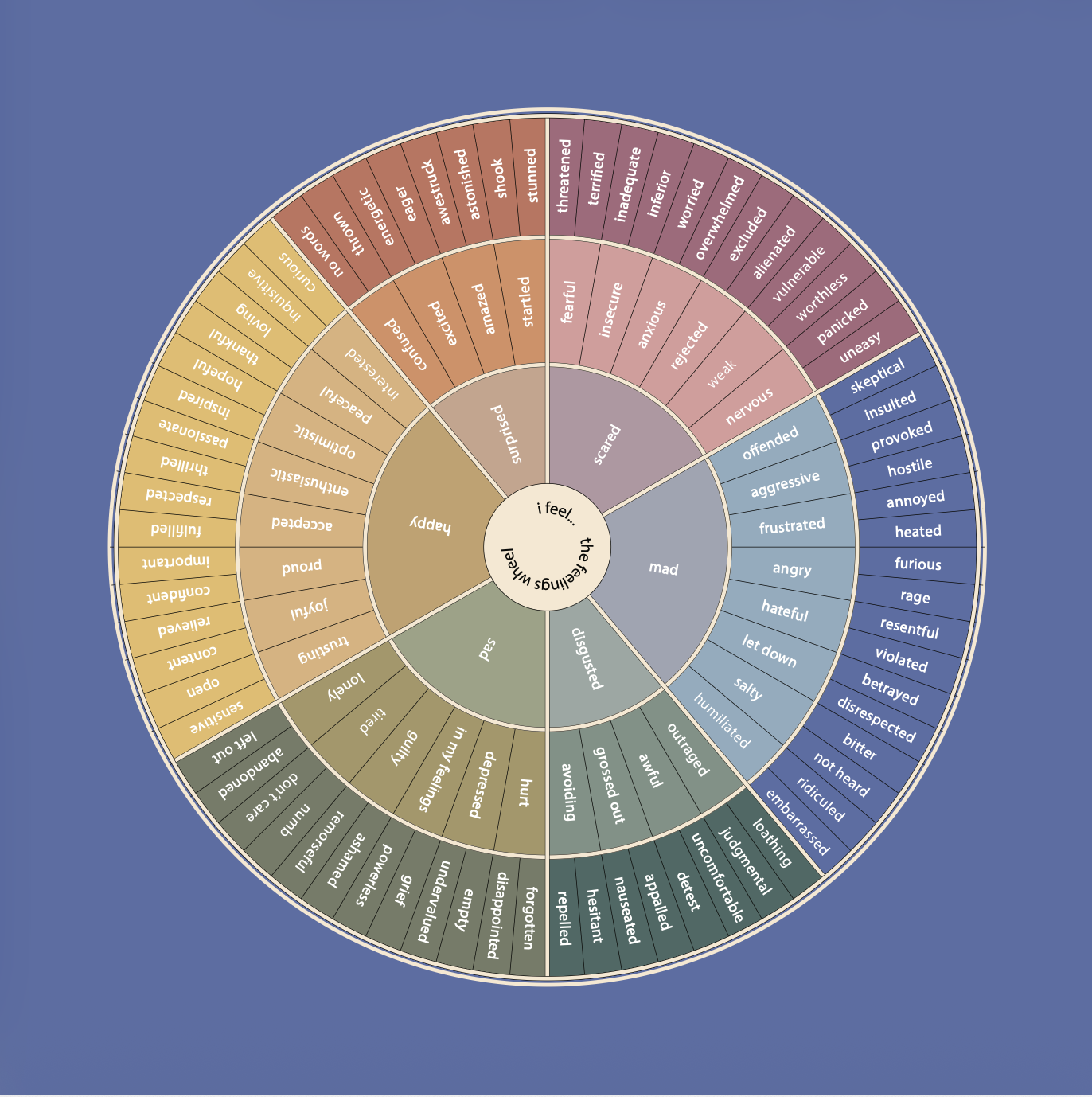
It’s worth taking a look for the conversations you know are coming this week.
One Reminder to Carry With You
Life is complicated. Our thoughts and emotions can get tangled and trip us up. So here’s a reminder worth holding onto when they do:
“Don’t worry about anything; instead, pray about everything. Tell God what you need, and thank him for all he has done. Then you will experience God’s peace, which exceeds anything we can understand. His peace will guard your hearts and minds as you live in Christ Jesus.” (Philippians 4:6-7, NLT)