What’s shaping you?
There are some notifications on my phone that I love to see. The book I reserved on Libby is finally available. The daily Scripture is ready to read. A text from my wife.
And then there are the less exciting ones. Like the Screen Time Report.
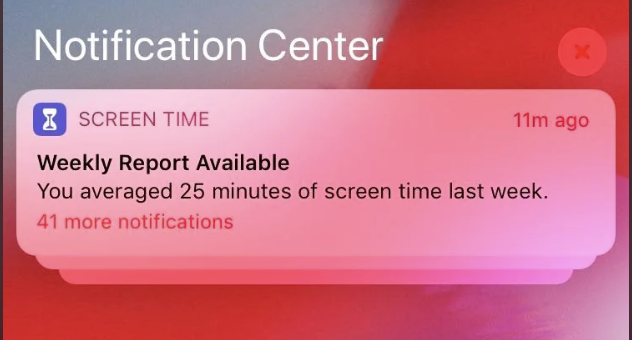
Every time that one pops up, I'm surprised. Surprised at how much time I spent on my phone, and surprised at where that time actually went. For most of us, it's probably not texting or calling, the kind of thing that builds real human connection. It's Netflix. It's social media. It's some other app that quietly ate our evening. And we spend so much time there that it's hard to deny a simple truth: your screen is shaping your life.
Neil Postman wrote about this in his book Amusing Ourselves to Death:
"Americans no longer talk to each other, they entertain each other. They do not exchange ideas, they exchange images. They do not argue with propositions; they argue with good looks, celebrities and commercials."
What's wild is that Postman wasn't writing about social media. He wasn't even writing in this century. He wrote that in 1985, watching television reshape the culture around him.
For decades we've been shaped by what we read, what we see, what we hear. And the pace has picked up dramatically since then. A 2026 Pew study found that 41% of adults say they are online almost constantly. It's hard to even quantify how much time we spend staring at a screen.
At some point we have to ask: if something has that much of our attention, is it possible it's doing more than just entertaining us? Is it possible it's shaping us?
You already know the answer, because you've lived it. You pull out your phone and somehow thirty minutes disappear. You read the news and suddenly you're on edge. A friend posts about a candidate you can't stand and your whole mood shifts. It doesn't matter if you follow Jesus or not, whether you're a man or a woman. It's a universal truth reshaping the world we live in.
You are what you scroll.
Your Feed Is Not My Feed
My wife Rebekah and I have been married for 24 years. We live in the same house. And our social media feeds look nothing alike. Hers is full of dogs, babies, and pop culture. Mine is fishing, lawn care, football, food, prayer, and for some reason a guy teaching people how to cut hair. I still don't know how that one got in there.
The digital world knows us better than we know ourselves. Every swipe, every like, every app we open is quietly molding us. Your screen is shaping your life, and it's doing it one tap at a time.
This is the first post in a short series about how we take back this part of our lives. And the place to start is asking a simple question: who, or what, actually has our attention?
What Jesus Said About Your Eyes
Matthew 6 has something surprisingly direct to say about this. Jesus put it this way:
"Your eye is like a lamp that provides light for your body." (Matthew 6:22a, NLT)
Jesus is using a metaphor that his Jewish audience would have understood immediately. The eyes were believed to be a window into the soul. What you see, you become.
Think about where so much of our struggle actually starts: jealousy, prejudice, greed, lust. A lot of it traces back to what we've been looking at. And once you see that, it changes what you're willing to give your attention to.
"When your eye is healthy, your whole body is filled with light. But when your eye is unhealthy, your whole body is filled with darkness." (Matthew 6:22b-23a, NLT)
If you've ever wondered why your heart feels distracted, cold, or disconnected from your faith, this might be exactly where to start. What am I actually looking at?
Here's the hard truth. If my feed is ungodly, I have little hope of living for God. The eye is a lamp, and it casts whatever light it takes in straight into the heart. If darkness is all I'm looking at, darkness is how I'll end up living.
There's a reason you're able to delete apps. There's a reason the unfriend and unfollow buttons exist. The mute button is there to help you. Whatever is pulling you down, pointing you in the wrong direction, or leading you astray needs to be dealt with, because your screen is shaping your life whether you're paying attention to it or not.
Philosopher James K.A. Smith puts it this way:
"It is crucial for us to recognize that our ultimate loves, longings, desires, and cravings are learned. And because love is a habit, our hearts are calibrated through imitating exemplars and being immersed in practices that, over time, index our hearts to a certain end."
Your heart is being indexed. It's being recalibrated by what you see, whether you notice it happening or not. You know this from experience. You love your house until you start scrolling Zillow and see a vineyard listed for $52 million, a go-kart track for $20 million, a pizza oven for $2 million. Suddenly your house feels different, and nothing about your house actually changed.
Zillow changes how you see your house. LinkedIn changes how you see your career. Instagram changes how you see your vacation. Influencers change how you see your body. Parenting content changes how you evaluate your family.
We tend to misunderstand what scrolling does to us. Yes, the algorithm shows you things you already like. But it also knows that if you see something enough, you'll start to like it, even if you didn't before.
Technology is not neutral. Every piece of it is designed to take you somewhere. Your phone makes connection and communication easier, and at the same time it makes silence and reflection a lot harder. You are being molded. You are being formed. And if you're not paying attention, you can become something you never wanted to be, losing the uniqueness God gave you in the process.
We don't need to order our lives around avoiding technology altogether. But we do need to put it in its proper place. Getting that right is worth the effort.
How Deep Is the Darkness?
Jesus names the risk directly:
"And if the light you think you have is actually darkness, how deep that darkness is!" (Matthew 6:23b, NLT)
Sit with that for a second. How discerning are you about what you let in? If what's entering your heart through your eyes is darkness, you will eventually be filled with it. It comes down to how honest you're willing to be with yourself.
Take an honest look at who you follow, which apps eat up most of your time. That's what has your attention. And if your attention is locked onto doom and gloom, onto content that does nothing to help you know Jesus, that's exactly where the darkness gets in.
Here's the uncomfortable part. We tend to assume whatever is in us is light, simply because it's the best we think we have to offer. And if it turns out to be darkness instead, we're in a lot more trouble than we realized.
So here's the real question. Is what holds my attention making me more like Jesus? The answer isn't always easy to sit with, but it's actually pretty simple to state: whatever has your attention shapes your life. So be careful what gets your eyes.
What do you actually look at the most during your day? Your week?
Where You Look Matters
If you want your faith to make a real impact, to leave something behind worth passing on, how you treat your attention matters. Hebrews 11 lists people worth imitating: Enoch, Noah, Sarah. Enoch walked with God and was taken to heaven without dying. Noah obeyed God and was found faithful. Sarah believed the promises God made her.
And right after that list, the writer tells us how to actually live that way:
"Therefore, since we are surrounded by such a huge crowd of witnesses to the life of faith, let us strip off every weight that slows us down, especially the sin that so easily trips us up. And let us run with endurance the race God has set before us." (Hebrews 12:1, NLT)
Keep going. Be faithful. Don't quit. And here's how:
"We do this by keeping our eyes on Jesus, the champion who initiates and perfects our faith." (Hebrews 12:2a, NLT)
The word translated "keeping our eyes on" is the Greek word aphoraō. It doesn't describe a spontaneous glance or an accidental shift in focus. It's an instruction: look away to. It implies that something else already has your attention, and you have to deliberately turn from it. The writer of Hebrews probably wasn't picturing a smartphone, but it's hard to imagine a more fitting description of our situation today.
We need to look away to Jesus.
If wholeness and faithfulness are what you're actually after, that's the whole strategy. Take your eyes off whatever is distracting you and put them on him.
Try This Tomorrow Morning
Tomorrow, the alarm on your phone is going to go off, and notifications will already be waiting. Emails, headlines, texts, reels, scores, updates, all of it lined up to tell you what matters before you've had a chance to decide for yourself.
So try something different. Before you scroll, look away to Jesus. Before you let the world tell you what deserves your attention, give your attention first to the one who's actually worthy of it.
Maybe that means reading a few verses before you open another app. Maybe it's sitting quietly for two minutes and praying something simple: Jesus, help me see today the way you see it.
You don't need to throw your phone away. You just need to decide what place it's allowed to have in your life.
Your attention is valuable. And whatever consistently gets it also gets the chance to shape you. Choose wisely.